Do Bidders Prefer Live or Online Farmland Auctions?
For generations, farmland auctions looked pretty much the same.
Buyers gathered at a community building, sale barn or local event center. The auctioneer stood at the front of the room, and farmers competed against one another for the opportunity to buy a farm.
It worked. And in the right situation, a live farmland auction can still work very well today.
But the way people buy and sell farmland has changed.
Online and hybrid auctions have become a much bigger part of agricultural real estate, giving sellers another way to reach buyers and create competition. And after more than a decade of conducting online farmland auctions, we’ve seen firsthand how much buyer behavior can change when you change the environment where the bidding takes place.
When DreamDirt began conducting online farmland auctions in 2009, the idea was met with plenty of skepticism. In fact, people in the industry laughed at us for trying it. There was a common belief that farmers simply wouldn’t be comfortable buying farmland online.
Seventeen years later, that belief looks pretty outdated.
Buyers who once questioned online bidding now use it regularly. Many tell us they actually prefer it. University research is showing the same broader shift toward online participation in agricultural real estate.
But I don’t think the most important part of this change is the technology itself.
It’s what the technology can change about the buyer.
Online bidding can make an auction more convenient, but it can also give buyers more privacy, better information and fewer distractions while they’re deciding what a farm is worth to them.
And when you’re selling farmland, anything that affects a qualified buyer’s willingness or ability to compete matters.
What Does the Data Say About Online Farmland Auctions?
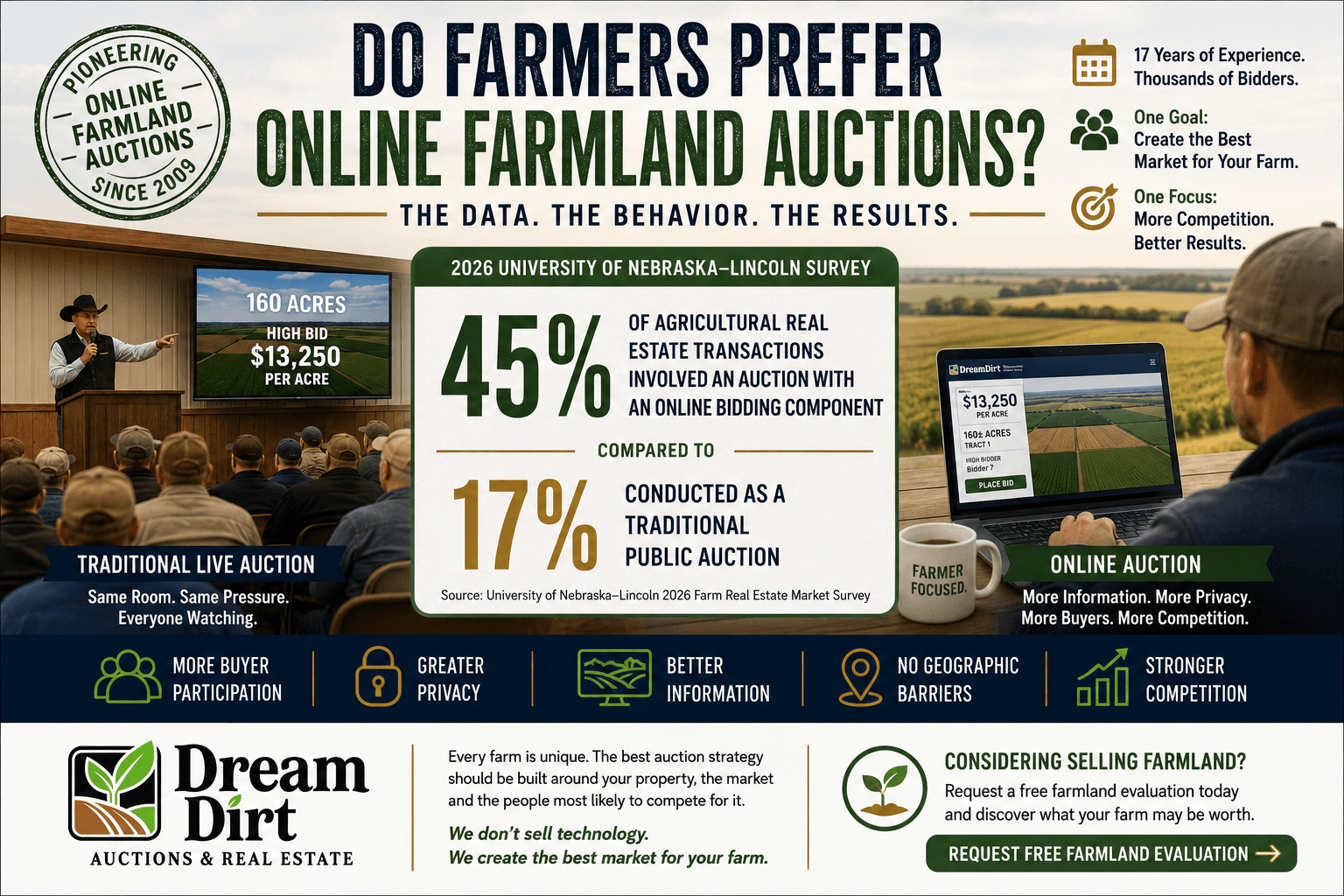
The University of Nebraska–Lincoln’s 2026 Nebraska Farm Real Estate Market Survey provides an interesting look at how agricultural real estate marketing is changing.
According to the survey, 39% of respondents reported increased use of hybrid online and public auctions over the previous five years. Another 27% reported increased use of online auctions.
The types of transactions being reported are just as telling.
Hybrid online/public auctions represented 31% of agricultural real estate transactions in the survey. Online-only auctions accounted for another 14%, while traditional public auctions represented 17%.
Put those first two numbers together, and 45% of the agricultural real estate transactions reported in the survey involved an auction with an online bidding component. That’s compared with 17% conducted as traditional public auctions.
The University of Nebraska–Lincoln also points out an important advantage of online bidding: buyers who aren’t local can participate without traveling to the auction or arranging for someone else to represent them.
That matters because participation, competition and reach are all important pieces of a successful farmland auction.
The goal isn’t simply to find someone willing to buy the farm.
The goal is to create the strongest possible marketplace and give qualified buyers every reasonable opportunity to compete.
DreamDirt Was Conducting Online Farmland Auctions Before They Were Popular
DreamDirt’s experience with online farmland auctions goes back to 2009.
We became the first company in the Midwest to conduct farmland auctions online. At the time, there was a widespread belief that farmers wouldn’t trust an online auction with something as valuable as farmland.
We kept going.
Over the years, DreamDirt also became the first company to broadcast a farmland auction through social media. We were constantly looking for ways to bring the auction to potential buyers rather than requiring every buyer to physically come to the auction location.
What seemed unusual in 2009 looks very different today.
The University of Nebraska–Lincoln’s 2026 survey now shows nearly half of the agricultural real estate transactions in its survey involved an auction with an online bidding component.
But being first isn’t what matters most.
What matters is what we’ve learned from watching buyers use these systems for 17 years.
We’ve seen what information buyers need. We’ve seen where technology makes the process easier and where poorly designed technology can create new barriers. Most importantly, we’ve watched how the auction environment can affect a buyer’s willingness to compete.
That’s why we don’t believe every farmland auction needs to be online.
We believe the auction format should be part of the overall marketing strategy.
The Auction Environment Can Change How People Bid
Auctions are financial transactions, but they’re also very human.
Researchers have studied things like competition, time pressure, emotional arousal and rivalry among bidders. Anyone who has spent much time around auctions has seen some version of this firsthand.
Sometimes a live crowd creates incredible energy.
Two determined bidders start going back and forth, each pushing the other a little higher. Before long, they’re bidding well beyond what anyone in the room expected.
That’s one of the reasons live auctions have worked so well for generations.
Farmland, however, brings another dynamic into the room.
The people competing against one another often know each other.
They’re neighbors. Their kids go to school together. They may attend the same church or serve together on a cooperative board or community organization. They may help each other during harvest or have families that have farmed next to each other for generations.
Then you put those same people in a room and ask them to publicly compete for a farm worth $1 million or $2 million.
That’s where things can get complicated.
The Social Pressure of Bidding Against Your Neighbor
I’ve seen this kind of pressure throughout my career.
Imagine a farmer believes a particular farm is worth another $50,000 to his operation.
Maybe it borders ground he already owns. Maybe his existing drainage infrastructure gives him an advantage. Maybe owning the farm would make his operation more efficient.
From a business standpoint, paying that extra $50,000 could make perfect sense.
But then he looks across the room and realizes the person bidding against him is his neighbor.
Maybe that neighbor has wanted the farm for years.
Now the decision isn’t simply:
“Is this farm worth another $10,000 to me?”
He’s also thinking:
What is my neighbor going to think?
Is he going to be upset with me?
What is everyone else in the room going to say?
Is another $10,000 worth creating tension with someone I’ll probably live next to for the next 30 years?
Those questions have nothing to do with soil productivity, CSR2 or the economic value of the farm to that particular buyer.
But they’re real.
And they can affect bidding.
That’s what I mean by social friction.
Nobody Wants to Be the Farmer Who “Ran Land Prices Up”
There’s another dynamic that many farmland buyers understand immediately.
Nobody wants to be known as the farmer who “ran land prices up.”
Let’s say a farm is bringing $13,000 per acre and you’ve independently determined that it’s worth $14,000 to your operation.
Maybe you own the adjoining farm. Maybe you already have drainage infrastructure in place. Maybe combining the property with your existing acres would create efficiencies that make the higher price worthwhile.
Those are legitimate business reasons to pay more.
But at a live auction, everyone gets to watch you make that decision.
If you eventually pay $14,000 an acre, people may talk about that sale for years.
You become the farmer who paid $14,000 when everyone else thought the ground was worth $13,000.
That judgment can become part of the bidding environment even though it has nothing to do with what the farm is actually worth to you.
From a seller’s perspective, I’d rather have buyers focused on one question:
What is this farm worth to me?
Not:
What is everyone else going to think if I pay that much?
The Auction Room Can Influence Buyers Before Bidding Even Starts
Anyone who has attended enough live farmland auctions knows how much conversation happens before the first bid.
Someone says, “That farm isn’t worth more than $12,000 an acre.”
Someone else agrees.
“I’d never pay that much.”
Maybe they’re right.
Maybe they’re wrong.
Maybe the person saying it plans to bid and is simply trying to convince everyone else that the farm isn’t worth very much.
Either way, those comments can create a psychological number in everyone’s head before the auctioneer ever asks for the first bid.
Now imagine another buyer has independently decided the farm is worth $13,500 to his operation.
He’s no longer simply deciding whether he’s willing to pay $13,500.
He’s also deciding whether he’s comfortable publicly paying $13,500 when everyone around him just said the farm wasn’t worth $12,000.
The room has now become part of the transaction.
What Happens When the Tenant Is Also Bidding?
This dynamic can become even stronger when the existing tenant wants to purchase the farm.
Imagine someone who has farmed the property for 30 years. Everyone knows he’s the tenant.
Before the auction, he tells people the farm is wet, rocky or doesn’t produce nearly as well as they think.
Who is going to have more credibility about that farm than the person who has actually farmed it for three decades?
Then the auction starts.
The tenant is sitting in the room and starts bidding.
Now another farmer isn’t simply bidding on a piece of ground. He’s publicly bidding against the person who has farmed that property for decades.
I’ve watched the pressure these situations can create.
There can also be informal understandings between potential buyers:
“Don’t bid against me on this farm and I won’t bid against you when the farm next to you sells.”
Again, none of these things necessarily reflect what the farm is actually worth.
But they can create a barrier between what a buyer believes the farm is worth and what he’s willing to publicly bid.
For the seller, the ideal marketplace is much simpler:
Qualified buyers independently decide what the farm is worth to them and compete to that number.
What Changes When You Move the Auction Online?
This is where online bidding becomes more than just a convenience.
It changes the environment where the buyer is making the decision.
A buyer can sit at home or in his office. His spouse can be sitting beside him. His banker can be on the phone.
He can have comparable sales, financing information and his own calculations right in front of him.
He doesn’t have to leave the farm at a specific time simply because that’s when the auction is scheduled.
And maybe most importantly, he doesn’t have to sit across the room from the person he’s bidding against.
He may not even know who that person is.
The tenant isn’t sitting ten feet away.
Nobody is watching his facial expressions.
Nobody knows how close he is to his maximum bid.
The rest of the community doesn’t need to know what he’s willing to spend.
The question becomes much simpler:
Is this farm worth the next bid to me?
That’s a cleaner business decision.
Online bidding doesn’t create value that wasn’t already there. It can create an environment that allows each buyer to independently express the value the property has to them.
Privacy May Matter Just as Much as Convenience
When online farmland auctions first started gaining traction, most of the conversation was about convenience.
You didn’t have to drive to the auction.
You could bid from home, the office, the pickup or even the combine.
Buyers from outside the area could participate without traveling.
Those advantages still matter.
But after years of watching buyers use online auctions, I think privacy may be just as important.
Buying farmland is a major financial decision. There isn’t much reason a buyer should have to publicly reveal his financial intentions to an entire community simply because he wants to purchase a farm.
Online bidding allows buyers to compete while keeping more of that decision private.
In a close-knit agricultural community, that can remove a significant amount of pressure from the transaction.
Better Information Can Lead to Better Competition
Technology can also make it easier for buyers to understand what they’re bidding on and where they stand.
This is one of the things that influenced how we developed our online bidding system at DreamDirt.
Simply putting an auction on the internet wasn’t enough.
We wanted the technology to actually make the buying process easier.
Iowa farmland provides a good example with CSR2.
Many Iowa buyers evaluate farmland partly in terms of dollars per CSR2 point. Our bidding system can calculate and display the current dollars per CSR2 point directly in the bidding window as the auction progresses.
Consider a buyer who has already decided he’d be comfortable owning a particular farm at around $175 per CSR2 point.
At a traditional live auction, he’s listening to the auctioneer while trying to keep track of the total purchase price, dollars per acre and dollars per CSR2—all while bids are coming quickly.
That’s a lot to process in a short amount of time.
If he gets his calculation wrong and thinks the auction has already passed his number, he may stop bidding.
That doesn’t necessarily mean he wasn’t willing to pay more.
He simply didn’t have the information available quickly enough to make the decision with confidence.
Good technology can remove some of that friction.
Showing dollars per acre or dollars per CSR2 doesn’t force someone to bid another dollar.
It simply gives the buyer better information so he can make his own decision.
The goal isn’t to make an auction digital. The goal is to make bidding easier, more informed and more competitive.
The Farmer Who Said Farmers Don’t Like Online Auctions
One auction we conducted in 2026 illustrates this change in buyer behavior better than almost anything else I’ve experienced.
Three siblings had inherited six farms.
One sibling was farming the properties, while the other two were primarily receiving rent from their ownership interests.
From the beginning, the farming brother was adamant that farmers didn’t like online auctions.
His siblings naturally put a lot of weight behind that opinion. He was the farmer in the family, and he also planned to bid.
His plan was to use part of his one-third share of the sale proceeds to purchase one or two of the smaller farms.
They wanted a live auction, so we agreed to conduct a live auction while also offering online bidding.
Auction day arrived.
We had everything set up at the auction location, and the two non-farming siblings came to the hall.
I asked where their brother was.
They told me he had decided to stay home and bid online.
The person who had been the most adamant that farmers didn’t like online auctions had been given a choice between attending the live auction and bidding online.
He chose online.
Then something even more interesting happened.
Not one bidder showed up for the live portion of the auction.
Every bidder participated online.
The farming brother ended up successfully purchasing one of the parcels from home.
Afterward, I called him because I genuinely wanted to know what changed his mind.
His answer was simple.
After going through the process and seeing how it worked, he realized he preferred it to going into town, standing in front of everyone and letting everybody know his business.
That experience has stuck with me.
Nobody forced those buyers to bid online.
The live auction was available. The auction room was ready.
The buyers made the choice themselves.
We’ve seen different versions of this over the years. Buyers who initially questioned online auctions often become comfortable with them once they understand the process. And when we’ve talked with successful bidders afterward, many have told us they preferred the online experience.
That auction demonstrated something we’ve believed since 2009:
Farmers weren’t necessarily opposed to buying land online.
They needed a system they could understand and trust.
Once they had that, privacy and convenience became advantages instead of obstacles.
Live Farmland Auctions Still Have a Place
None of this means live farmland auctions are going away.
We’ve conducted plenty of successful live auctions, and there’s no denying the energy a crowd can create.
Sometimes that competitive atmosphere is exactly what a property needs.
That’s why I don’t think the question is whether live or online auctions are universally better.
The better question is:
Which environment gives the qualified buyers for this particular property the best opportunity to compete?
Sometimes the room creates momentum.
Sometimes it creates pressure.
Sometimes relationships encourage competition.
Sometimes those same relationships keep someone from bidding as aggressively as they otherwise would.
The job of an experienced farmland auction company is to understand those dynamics and build the marketplace around the property and the buyers.
We’re Not Committed to Technology. We’re Committed to Competition.
This distinction is important.
DreamDirt isn’t committed to online auctions simply because they’re online.
We’re committed to creating the strongest possible marketplace for the seller.
The auction format is a tool.
The objective is competition.
A good farmland auction should make it easy for buyers to find the information they need. They should understand the property, know where they stand during the bidding and be able to compete without unnecessary barriers.
That’s the philosophy that took us online in 2009 when much of the industry thought the idea was crazy.
It’s what led us to broadcast farmland auctions through social media.
It’s what led us to develop technology specifically for land auctions.
And it’s what still guides us today.
The technology will continue to change.
The objective won’t.
The Auctioneer’s Job Is to Create the Marketplace
An auctioneer’s job isn’t simply to stand in front of a crowd and call bids until everyone stops.
The work starts much earlier.
We determine how the property is presented.
We determine how buyers receive information.
We determine how easy it is to participate.
We determine how the bidding works.
And ultimately, we help create the environment where buyers are asked to decide what the farm is worth to them.
There’s an important distinction here:
The highest bidder isn’t necessarily the person who was willing to pay the most.
He’s the person who was willing to express the highest bid in the environment that was created.
What if another qualified buyer was actually willing to pay more, but something about the auction environment kept him from expressing it?
That’s why auction method matters.
An auctioneer can’t create economic value that doesn’t exist.
But an auctioneer can create—or remove—barriers that keep willing buyers from expressing the value that’s already there.
For decades, the traditional auction room was the best way we had to bring buyers together and create competition.
Today, we have another option.
We can bring the competition to the buyers.
We can give them more information and privacy, eliminate geographic barriers and reduce some of the social pressure that comes with neighbors publicly competing against neighbors for farmland.
The basic principles of a successful auction haven’t changed:
Exposure. Information. Urgency. Transparency. Competition.
What’s changed is our ability to create those conditions.
So, Do Farmers Prefer Online Farmland Auctions?
Back in 2009, people laughed at the idea that farmers would buy farmland through an online auction.
Seventeen years later, the University of Nebraska–Lincoln is reporting that 45% of the agricultural real estate transactions in its survey involved an auction with an online bidding component, compared with 17% conducted as traditional public auctions.
Our own experience over those 17 years tells a similar story.
When buyers are given the choice, we’re seeing more of them choose online bidding.
And research into auction behavior reinforces something experienced auctioneers have understood for years:
The environment where people bid can affect how they behave.
So maybe the question isn’t really:
“Will farmers bid online?”
We already know the answer.
They will.
The better question for a farmland seller is:
What auction environment gives every qualified buyer the greatest freedom, information and opportunity to compete for my farm?
Because at the end of the day, you’re not hiring an auctioneer simply to conduct an auction.
You’re hiring an auctioneer to create a market.
Every decision—from advertising and property information to technology and auction format—can either add friction to that market or remove it.
Our responsibility is to give every qualified buyer the best possible opportunity to compete.
The final sale price isn’t determined simply by who wanted the farm the most.
It’s also influenced by how effectively the marketplace allowed those buyers to express what the farm was worth to them.
Considering Selling Farmland?
Every farm is different.
The right marketing strategy, auction format and buyer outreach should be based on the property, the market and the buyers most likely to compete for it.
If you’re considering selling farmland, DreamDirt can help you determine what your farm may be worth, identify the likely buyer pool and develop a marketing and auction strategy designed to create the strongest possible competition.
Start with a free farmland evaluation and find out what your farm may be worth.
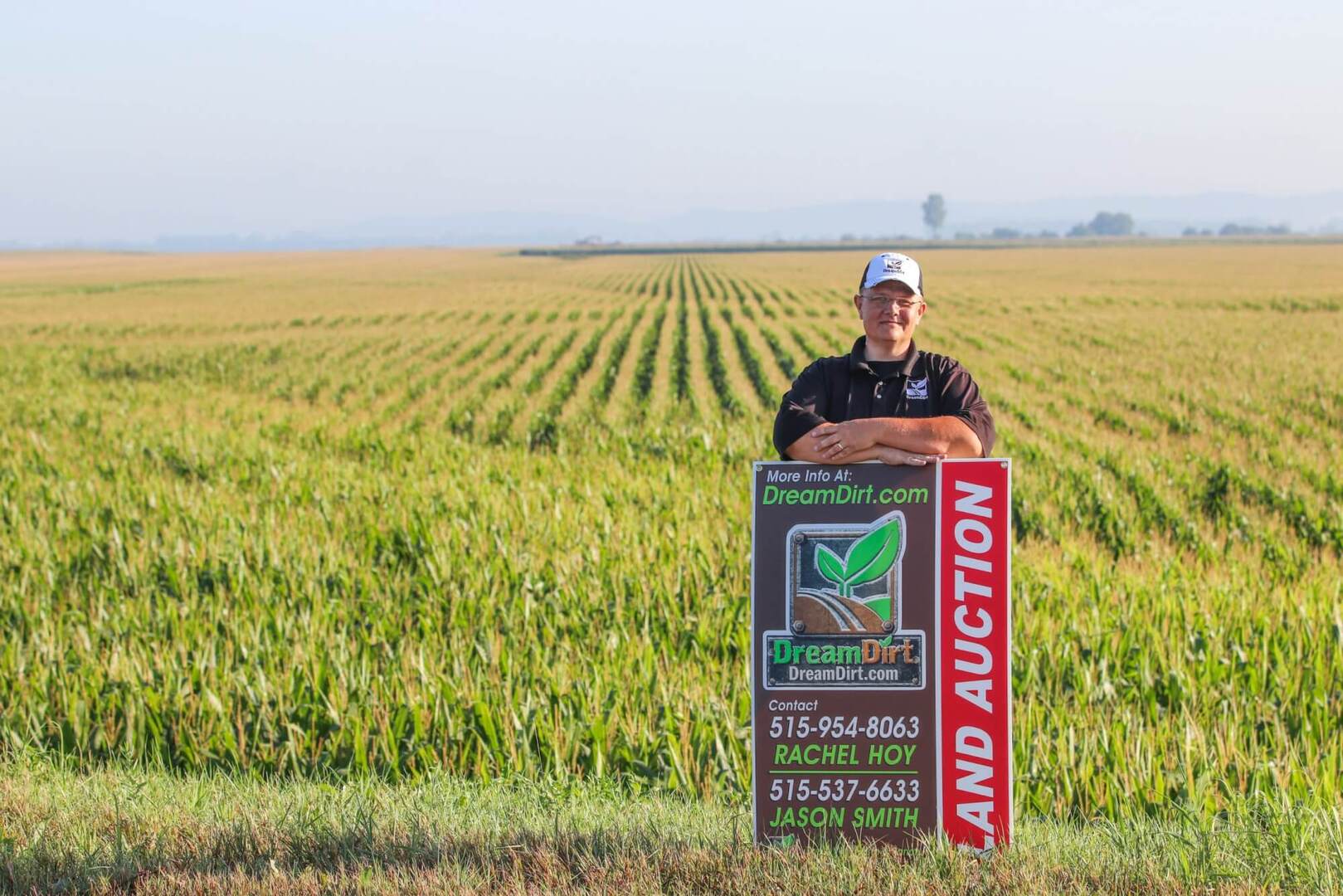
Jason J Smith
Auctioneer & Land Broker
Jason Smith is an experienced farmland broker and auctioneer with extensive experience helping landowners sell farmland across the Midwest. As the founder of DreamDirt and a licensed real estate broker and auctioneer, Jason has worked with hundreds of landowners to navigate farmland sales and create advantageous outcomes.
If you're considering selling farmland, schedule a confidential consultation with Jason to discuss your property, current market conditions and your selling options.
Phone: 515-537-6633 Email: Jason@dreamdirt.com
Request a Valuation for Your Farm or Land Property
Whether you’re ready to start the selling process, or even remotely curious, we will gladly provide you with a free consultaiton with a complementary Market Analysis! If you are in a position to sell land in the Midwest, we want to help you achieve the top of the market on your sale.
What July 2026 Iowa Farmland Auctions Tell Us About Land Values
July 2026 Iowa Farmland Auction Results: A Stable Market With Wide Local Variation Iowa farmland auctions picked up in July 2026, giving us a larger group of sales to evaluate as we head toward the traditionally busier late-summer and fall land market. A total of...
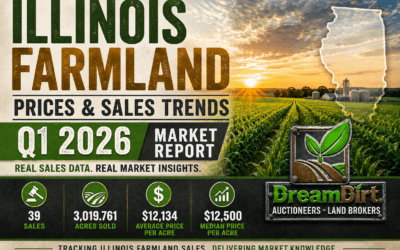
Illinois Farmland Prices & Sales Trends – Q1 2026 Market Report
Welcome to Our Quarterly Illinois Farmland Value Report In this quarterly report, Rachel Tiffany, Land Broker and Auctioneer dives into Illinois farmland values, helping you understand the factors that determine what your farm is potentially worth. Our goal as...
Why Farmland Doesn’t Always “Pencil Out” — And Why That Matters
I hear it all the time: “Land is too high.” Some blame greedy sellers. Others say the numbers just don’t work. Most of the time, what they really mean is this: They’re comparing today’s land prices to today’s grain prices—and deciding it doesn’t make sense. But here’s...