Nebraska Farmland Values in 2026: What the Latest Numbers Tell Us
If you own farmland in Nebraska and have been wondering whether land prices are still climbing, leveling off or beginning to retreat, the latest numbers suggest the answer depends quite a bit on what kind of land you own and where it is located.
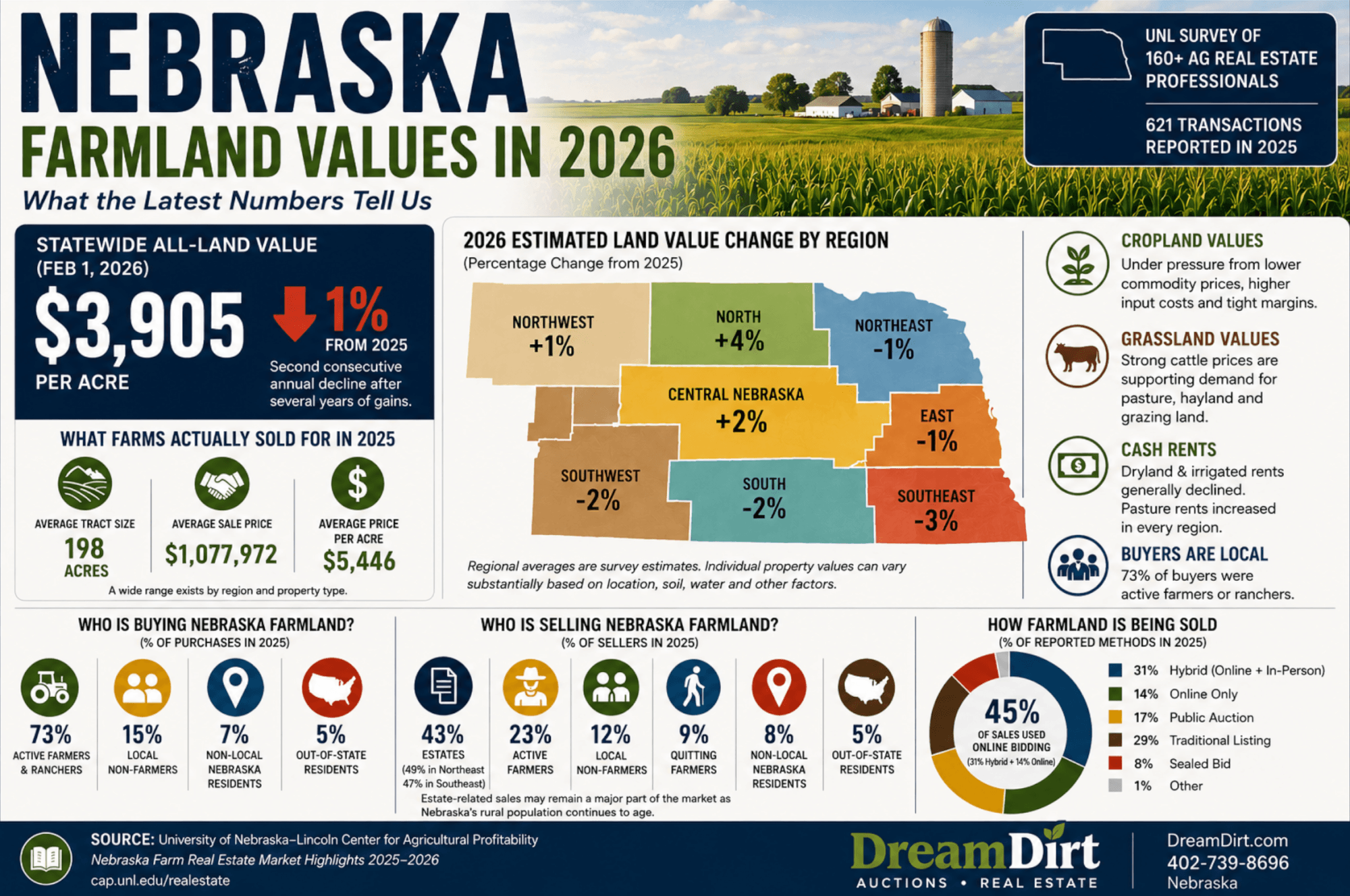
The University of Nebraska–Lincoln recently released its Nebraska Farm Real Estate Market Highlights 2025-2026, and there is a lot in the report worth paying attention to. UNL has been conducting this research for decades, and the 2026 survey included nearly 160 professionals involved in Nebraska agricultural real estate, including appraisers, farm managers, agricultural lenders and others actively working in the landmarket. The report also includes information from 621 agricultural real estate transactions during 2025, which gives us more than opinions about where the market is headed. It gives us a good look at what has actually been happening.
The headline number is fairly simple. Nebraska’s statewide all-land average was estimated at $3,905 peracre as of February 1, 2026, about 1% below the previous year. This was the second consecutive annual decline after the substantial run-up in Nebraska farmland values during the previous several years.
I wouldn’t read too much into that 1% decline by itself.
Nebraska isn’t one land market. A productive eastern Nebraska grain farm, an irrigated farm in central Nebraska and a large grazing property farther west may all be called Nebraska agricultural real estate, but the economics behind those properties can be very different. Even two farms within the same county can bring considerably different prices.
UNL makes that point in the report as well. Location, soil type, topography, water availability and local competition can cause an individual farm to vary substantially from a regional average. Some of UNL’s reporting districts cover enormous geographic areas, so the numbers are best viewed as a measure of the market rather than a price sheet for an individual farm.
That distinction is especially important if you arrived at this article trying to determine what farmland is worth in Gage County, Otoe County, Richardson County or somewhere else in Nebraska. Regional averages can give us a starting point. They cannot tell us exactly what your farm is worth.
Nebraska Land Prices Are Not Moving in One Direction
While the statewide average declined 1%, three of UNL’s eight regions actually increased. The North District was up 4%, Central Nebraska increased 2% and the Northwest increased 1%. The Northeast and East declined about 1%, the Southwest and South declined 2%, and Southeast Nebraska declined 3%.
There is an even more interesting difference underneath those regional numbers. Cropland and grassland are not behaving the same way.
UNL reports that competition for cropland has moderated as crop producers deal with commodity prices, higher input expenses, borrowing costs and tighter margins. The cattle side of agriculture has been considerably stronger, and that has helped support demand for pasture, grazing land and hayland.
The economic factors reported by UNL tell much the same story. Crop prices, interest rates and farm input costs were among the strongest negative forces affecting agricultural land values in 2026. Livestock prices were a positive influence, along with 1031 exchanges and non-farmer investor interest.
None of that should be particularly surprising to someone actively farming or ranching right now, but it is important when we’re evaluating land. We sometimes talk about “farmland” as though every acre derives its value from the same thing. It doesn’t. A property with productive cropland, pasture, hay ground, reliable water or recreational characteristics can have several different sources of demand, and those buyers may look at the property very differently.
Cash rents are showing the same split. UNL reported lower dryland rents throughout Nebraska in 2026, with declines ranging from 2% to 9%. Irrigated cropland rents generally moved lower as well. Pasture rents went the other direction and increased in every reporting district.
What Nebraska Farms Actually Sold For
The transaction data in the report are probably more interesting to me than the statewide average because they give us another way to look at the market.
Across the 621 transactions reported to UNL for 2025, the average tract contained 198 acres and sold for $1,077,972, or $5,446 per acre.
That $5,446 number is quite a bit different from the $3,905 statewide all-land value estimate, and there is a reason. The mix of properties actually being sold isn’t necessarily representative of every acre of agricultural land in Nebraska.
Look at the regional transaction numbers and the differences become obvious. The East District averaged $9,484 per acre on reported transactions and the Northeast averaged $9,317. Southeast Nebraska averaged $7,928, while the South averaged $5,093 and Central Nebraska $4,869. The Northwest averaged $1,103 per acre and the North $1,421, but those transactions were much larger and contained far more pasture.
The average transaction in eastern Nebraska was only 107 acres. In the North District it was 1,279 acres.
Those numbers shouldn’t be compared without understanding what is actually being sold.
This is also why I’m cautious when someone asks, “What’s Nebraska farmland worth per acre?” It’s a reasonable question, but there isn’t one number that gives a very useful answer.
What About Farmland Prices in Individual Nebraska Counties?
This deserves some explanation because most landowners don’t think in terms of Agricultural Statistics Districts. They think in terms of counties.
If someone owns a farm in Gage County, they’re probably going to search for Gage County farmland prices. Not the UNL Southeast Agricultural Statistics District.
UNL places Gage County within its Southeast Nebraska reporting region along with Clay, Fillmore, Jefferson, Johnson, Nemaha, Nuckolls, Otoe, Pawnee, Richardson, Saline and Thayer Counties.
That makes the Southeast figures useful when we’re evaluating farmland in those counties, but they are still regional figures. We should not say that Gage County farmland declined 3% simply because UNL’s Southeast District declined 3%. UNL did not make that claim.
The same caution applies when someone is researching Otoe County farmland values, Richardson County land prices, Jefferson County farmland, Saline County land values or any other county within the region. The regional data establish context. Recent sales and the characteristics of the individual farm establish much more.
Soil productivity, irrigation, percentage of tillable acres, water, drainage, access, improvements, tract configuration and location all matter. There is another variable that is harder to put into a spreadsheet: who wants the farm and how badly they want it.
A farm located between several financially strong operators looking to expand can behave very differently at sale than a physically similar farm with a thin local buyer pool. That’s one of the reasons I don’t like putting too much faith in an average price per acre when we’re trying to determine what a particular farm may actually bring.
Nebraska Farmers and Ranchers Are Still the Buyers
There has been plenty of discussion over the last several years about investors, institutions and outside money buying American farmland. Those buyers exist, but the UNL numbers don’t show them replacing farmers and ranchers in Nebraska.
Active farmers and ranchers accounted for 73% of reported agricultural land purchases in 2025. Local non-farmers accounted for another 15%, non-local Nebraska residents 7%, and out-of-state buyers only 5%.
That is useful information for a seller because it confirms something we continue to see in farmland sales: the local agricultural community is still extremely important.
The neighbor across the road may be the best buyer. So might the operator three miles away who has wanted that farm for 20 years. Those people need to know the property is for sale, and the marketing has to reach them.
At the same time, I wouldn’t interpret the UNL numbers as an argument for marketing a farm only locally. More than one-quarter of reported purchases came from someone other than an active farmer or rancher, and even an active farmer bidding on a property may not live close enough to attend a traditional auction conveniently.
The goal should be to reach the local buyers and everyone else with a legitimate reason to compete.
Nearly Half of Nebraska Farmland Sellers in the Report Were Estates
This may be the statistic in the entire UNL report that deserves the most attention over the next decade.
Estates accounted for 43% of the sellers in the 621 Nebraska transactions reported for 2025. Active farmers were the next largest group at 23%. Quitting farmers represented 9%, local non-farmers 12%, non-local Nebraska residents 8% and out-of-state residents 5%.
In eastern Nebraska the estate percentage was even higher. Estates represented 49% of reported sellers in the Northeast and 47% in the Southeast. UNL points out that estate-related sales may remain a substantial part of the agricultural real estate market as Nebraska’s rural population continues to age.
I think that has implications beyond simply putting more farms on the market.
Increasingly, the person deciding what to do with a Nebraska farm may not be the person who farmed it.
An inherited farm may belong to three or four siblings. One might still live nearby while another lives in Omaha and another has moved out of state. One may know exactly what the soils are and what the farm has historically produced, while another has never looked at a soil map. They may also have completely different financial circumstances and different emotional connections to the farm.
Those families need good information before they need a sales pitch.
If you’ve inherited farmland, one of the first things worth determining is what the property is likely worth in the current market and why. After that, the family can make a much better decision about keeping it, renting it, selling it or restructuring ownership.
The Way Nebraska Farmland Is Being Sold Has Changed
UNL devoted a special section of this year’s report to something DreamDirt has watched develop for a longtime: the changing way farmland auctions are conducted.
Over the previous five years, 39% of respondents reported increased use of hybrid online and public auctions, while another 27% reported increased use of online auctions. Twenty-one percent said methods remained unchanged, 8% reported decreased use of public auctions, and 5% reported delayed sales.
The transaction-method numbers are even more interesting. Hybrid auctions represented 31% of reported methods, traditional listings 29%, public auctions 17%, online auctions 14%, sealed bids 8% and other methods 1%.
In other words, online-only and hybrid auctions together accounted for 45% of the reported methods.
I have a little different perspective on that statistic because DreamDirt began conducting online farmland auctions in the Midwest in 2009, when selling farmland online was anything but conventional. At the time, there were plenty of people in the auction business who didn’t think buyers would accept it. Seventeen years later, UNL’s research shows how thoroughly online participation has become part of the Nebraska agricultural real estate market.
That doesn’t mean I believe every farm belongs in an online auction.
Neither does UNL’s research. When its respondents were asked what should determine the use of online or hybrid auctions, the type of land was the leading consideration, followed by broker guidance, location and bidder characteristics.
That’s the right way to look at it. Choose the method for the farm rather than choosing the farm for the method.
What I do believe strongly is that a seller benefits when qualified buyers can participate easily.
UNL notes that online and hybrid bidding gives non-local buyers additional opportunities to participate without traveling or arranging local representation and allows a property to be exposed to buyers across Nebraska and surrounding states.
There is another part of this that is harder for a university survey to measure.
Farm communities are small. The bidders at a farmland auction may have children in school together. They may attend the same church, serve on the same boards, do business together, rent ground from oneanother or have been neighbors for 40 years. In a traditional auction room, everyone can see who is bidding against whom.
I’ve watched that social pressure affect people.
A bidder may know exactly what a farm is worth to his operation and still hesitate to publicly bid against a neighbor or tenant. Someone in the room can make a comment about what the farm is “worth,” and suddenly everyone else has to decide whether they’re willing to visibly disagree with him.
Online bidding doesn’t make buyers want the farm more. It simply allows them to make their own decision about value without some of that social friction.
From the seller’s perspective, that’s important. An auction isn’t really about gathering people into a room. It’s about creating an environment in which every qualified buyer can compete to the maximum level he or she believes the property is worth.
So Is 2026 a Good Time to Sell Nebraska Farmland?
I don’t think anyone can responsibly answer that question for every Nebraska landowner.
There are real headwinds in the market. Crop margins are tighter. Financing remains expensive. Input costs are high. UNL’s statewide land value has now declined modestly for two consecutive years.
But a 1% statewide decline doesn’t mean Nebraska suddenly has a poor farmland market.
Farmers and ranchers are still buying land. Strong cattle economics are supporting grassland. Investors and 1031 exchange buyers remain part of the market. Significant agricultural properties continue to change hands.
More importantly, people rarely sell farms solely because a statewide index moved up or down 1%.
A family may be settling an estate. A retiring farmer may want to simplify his affairs. Siblings may inherit a property none of them intends to farm. An absentee owner may decide that the return from renting the property no longer justifies keeping the capital tied up in it. Another family may have no intention of selling regardless of what the market does.
Trying to pick the absolute top of any asset market is difficult. I would rather help a landowner answer two questions we can actually investigate:
What is this farm likely worth in today’s market and can today’s market accomplish what the owner needs it to accomplish?
If the answer to the second question is no, there may be no reason to sell.
If the answer is yes, waiting for someone to predict the next 1% move in Nebraska farmland values may not improve the decision.
What Is My Nebraska Farm Worth?
If you came to this article looking for a Nebraska farmland price per acre, hopefully the numbers above have given you a useful benchmark. They should also demonstrate why we need more information before putting a value on an individual property.
At DreamDirt, we look at recent comparable sales, soil and productivity information, land use, water and irrigation where applicable, improvements, tract configuration and current market conditions. We also look closely at the likely buyer pool because ultimately buyers (not averages) determine the sale price.
If you own farmland in Nebraska and are considering a sale, settling an estate, dealing with inherited farmland or simply wondering what the property may be worth, DreamDirt can prepare a confidential market evaluation before you make any decision to sell.
There is no reason you should have to commit to an auction just to find out what your farm may be worth.
Request a confidential Nebraska farmland value estimate from DreamDirt Auctions & Real Estate.
We can help you understand the market, the likely buyers and the selling options available for the property. From there, you can decide what makes sense for you and your family.
About the Data Used in This Article
The primary independent source for this analysis is the University of Nebraska–Lincoln Center for Agricultural Profitability’s Nebraska Farm Real Estate Market Highlights 2025-2026, prepared by Jim Jansen, Agricultural Economist.
The 2026 survey included nearly 160 professionals engaged in Nebraska agricultural land markets and information concerning 621 representative agricultural real estate transactions occurring during 2025.
UNL’s reported land values are regional survey estimates. They are not appraisals or county-specific estimates, and UNL cautions that individual properties can vary substantially because of location, soil, topography, water and local market conditions.
The observations in this article concerning auction strategy, bidder behavior and DreamDirt’s experience with online farmland auctions represent DreamDirt’s professional experience and analysis rather than findings attributed to UNL.
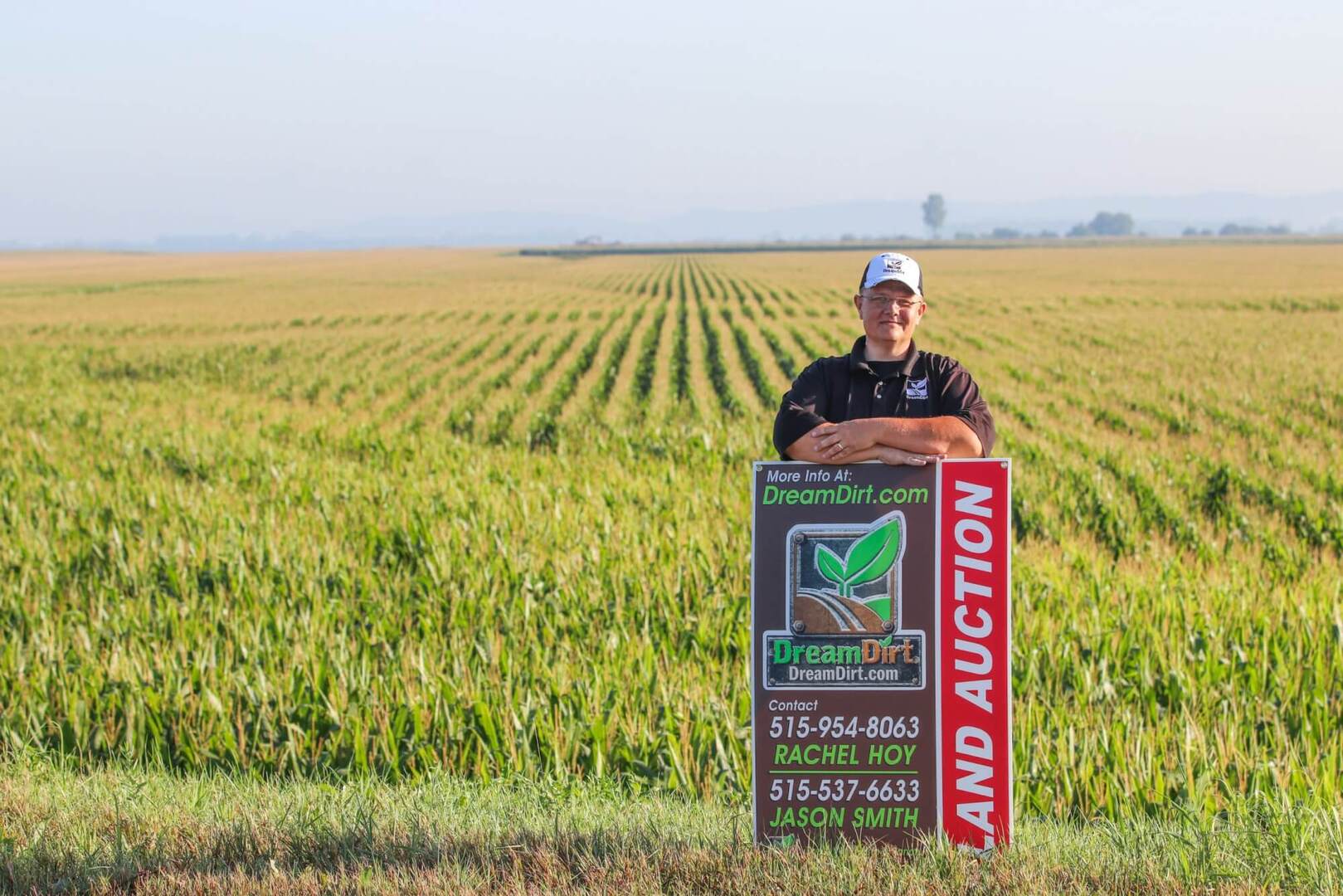
Jason J Smith
Auctioneer & Land Broker
Jason Smith is an experienced farmland broker and auctioneer with extensive experience helping landowners sell farmland across the Midwest. As the founder of DreamDirt and a licensed real estate broker and auctioneer, Jason has worked with hundreds of landowners to navigate farmland sales and create advantageous outcomes.
If you're considering selling farmland, schedule a confidential consultation with Jason to discuss your property, current market conditions and your selling options.
Phone: 515-537-6633 Email: Jason@dreamdirt.com
Request a Free Valuation for Your Farm or Land Property
Whether you’re ready to start the selling process, or even remotely curious, we will gladly provide you with a FREE Market Analysis! If you are in a position to sell land in the Midwest, we want to help you achieve the top of the market on your sale.
Do Bidders Prefer Live or Online Farmland Auctions?
For generations, farmland auctions looked pretty much the same. Buyers gathered at a community building, sale barn or local event center. The auctioneer stood at the front of the room, and farmers competed against one another for the opportunity to buy a farm. It...
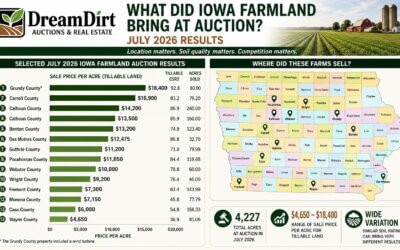
What July 2026 Iowa Farmland Auctions Tell Us About Land Values
July 2026 Iowa Farmland Auction Results: A Stable Market With Wide Local Variation Iowa farmland auctions picked up in July 2026, giving us a larger group of sales to evaluate as we head toward the traditionally busier late-summer and fall land market. A total of...
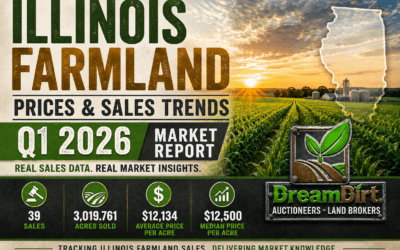
Illinois Farmland Prices & Sales Trends – Q1 2026 Market Report
Welcome to Our Quarterly Illinois Farmland Value Report In this quarterly report, Rachel Tiffany, Land Broker and Auctioneer dives into Illinois farmland values, helping you understand the factors that determine what your farm is potentially worth. Our goal as...