What I’ve Learned From 1,000+ Farmland Auction Clients
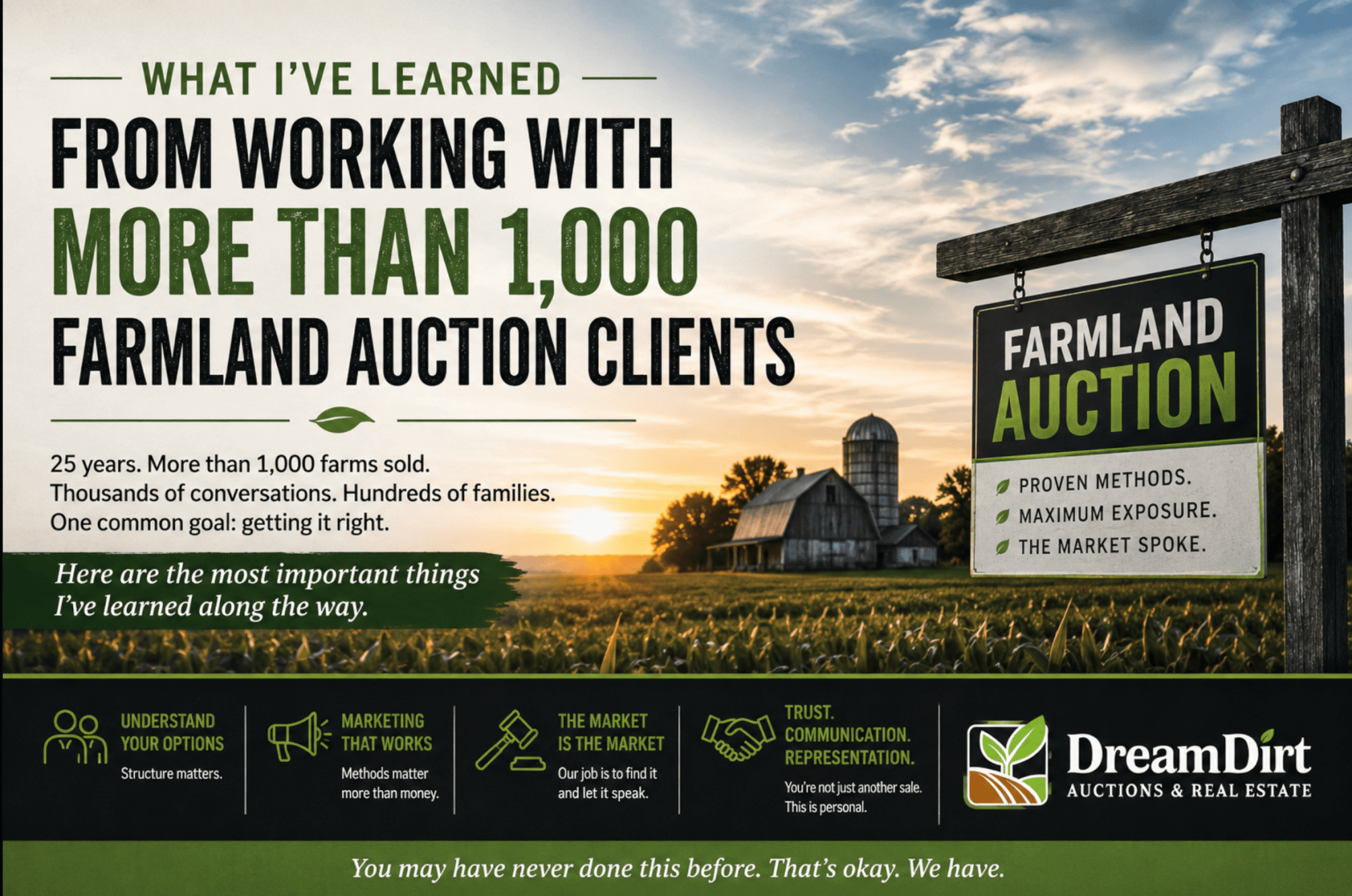
What I’ve Learned From Working With More Than 1,000 Farmland Auction Clients
There is one sentence I’ve heard probably more than any other in 25 years of selling farms: “I’ve never done this before.”
Of course you haven’t. Most people will buy and sell quite a few things during their lifetime. Cars, houses, machinery, maybe a business, but you probably only get one family farm and when it comes time to sell it there’s a good chance you’ve never sold one before. I have sold more than 1,000 tracts of land over the last 25 years and worked with well over 1,000 farmland auction clients. A lot of those farms were owned by families, estates and trusts, so sometimes there are two or three people involved, sometimes there are ten. The most I’ve dealt with on one farm so far was 19.
After doing this that many times you start hearing the same questions. You see the same fears and some of the same mistakes too. I think one of the first things I’ve learned is that sellers are usually more nervous than they let on, and I understand why. This might be a million-dollar decision, maybe several million. It might be land your grandfather bought or your great-great-grandfather bought. Maybe Dad just died and you’re trying to settle his estate while you’re still trying to get your head around the fact that he isn’t here anymore.
Then an auctioneer starts talking about reserves, terms, possession, closing, surveys, bidding procedures, marketing, earnest money and ten other things you’ve never had a reason to think about before. It can get overwhelming pretty quickly.
One thing I wish more sellers understood from the beginning is that you don’t need to know all of it. You don’t need to become an expert in farmland auctions to sell your farm. You need to understand the decisions you’re making, know what your options are and understand why we’re recommending what we’re recommending. We can walk you through the rest.
A lot of questions I get start with, “Can we?”
“Can we keep possession of the house for 40 days after closing?” Yes, we just need to structure it properly before the auction.
“Can we set a minimum?” Absolutely.
“Can we give a family member an opportunity to buy?” Usually we can, but let’s talk about what you’re trying to accomplish and figure out the right way to do it.
You would probably be surprised how often my answer to a seller’s unusual request is “yes, we can do that,” but the important part is getting it structured correctly ahead of time.
Auctions have laws and rules and there are terms and conditions that govern the sale. Those things matter a lot more than most sellers realize. In fact, I think terms and conditions are probably one of the most overlooked parts of choosing an auction company. Sellers naturally look at advertising, commission, websites, signs and maybe how many followers an auction company has, but they don’t always ask to see the terms and conditions. They should.
Terms and conditions are not necessarily the same from one auction company to another. They establish the rules of the sale and can determine what happens when something goes wrong, what rights the seller has, what obligations the buyer has, how possession works and what happens after the bidding ends. A lot of problems can be avoided simply by thinking through the possibilities before the auction starts. We would much rather solve a potential problem on paper three weeks before an auction than try to figure it out when there is a buyer standing there with money on the line.
Advertising is another area where I’ve learned that what sellers initially think matters and what actually matters can be a little different. Almost everyone understands that advertising is important and they’re right. You absolutely have to expose a farm to the market. If the right buyers don’t know it’s for sale, they can’t bid on it. But there is also a point of diminishing returns where you can spend yourself silly advertising a farm and eventually you’re just burning money without creating additional value.
What matters is how the advertising is done. What does it say? What photographs did you use? How is the farm presented? What information did you include? Where did you distribute it? Who saw it and how often did they see it? Did the advertising give someone a reason to stop what they were doing and actually look at the farm? Two auction companies can spend exactly the same amount of money advertising a farm and get very different results. The method matters as much as the money spent.
I’ve also learned that sellers sometimes worry a lot about things that, after doing this as long as I have, really aren’t the things I worry about. One example is where we start the bidding. We routinely start farms at $1,000 an acre and that can make somebody nervous. They’ll ask, “What if you sell it for $1,000 an acre?” We aren’t going to sell your million-dollar farm for $1,000 an acre. Where an auction starts doesn’t matter nearly as much as where it ends.
There is a process to building an auction. You want people bidding. You want momentum and competition. You want bidders participating instead of sitting on the sidelines waiting for somebody else to establish the value. There is even an element of imagined ownership that develops as someone participates in an auction and begins thinking of that farm as something they could actually own. The $1,000 opening bid isn’t our opinion of the farm’s value, it just gets the process started.
Then there is the question I get on nearly every reserved auction: “What if we don’t get our minimum?”
Then we go to Plan B. We don’t throw our hands in the air and go home. We have bidders engaged, we know who has interest and we know where the market stopped. Depending on the situation, we may continue working with those bidders to see if there is room to negotiate a transaction.
“What if nobody bids?” I’ve never had that happen on a farm, but if it did we would back up, figure out why and go to Plan B there too. A good auction plan shouldn’t depend on everything going perfectly. We should already have some idea of what we’re going to do if it doesn’t.
Another thing sellers worry about is losing control. Some people actually believe that once they hire an auctioneer, I can yell “sold” and suddenly they’re stuck selling their farm for whatever number I said. That IS NOT how a properly structured reserved farmland auction works. You are still in control.
You can have a minimum. You approve the terms. You decide how possession will be handled. We cannot sell your farm without your agreement, signature or prior authorization to do so. A reserved auction can actually give a seller a tremendous amount of control because we establish those rules before the bidders ever show up. You aren’t handing us your farm and hoping for the best, you’re hiring us to represent you.
Setting the reserve is another thing sellers struggle with because most people genuinely have no idea where to start. “We don’t know what our minimum should be. Can you help us?” Yes, and actually we start working on that from day one.
We do a market analysis and look at comparable sales, soils, productivity, location, current demand and everything else we think affects the farm. We form an opinion of the market and talk it through with you.
As a general rule, we often suggest a reserve somewhere around 80% to 90% of our market analysis, but that isn’t a hard rule because every situation is different.
One thing I generally don’t like, if maximizing price is the goal, is carrying a high reserve all the way to the very end of the auction. At some point you want bidders competing with each other for ownership instead of competing against the seller’s minimum and the negative emotion that can introduce.
Sometimes there are reasons we have to do it differently. Maybe a family can’t agree ahead of time.
Maybe trustees need to meet. Maybe there are several beneficiaries who need time to discuss the result.
We can deal with that too. Our terms provide a period after the auction when the buyer’s high bid remains valid, giving the sellers time to meet, talk and make a decision when that’s necessary.
Family dynamics are probably one of the hardest parts of this business. Money can tear families apart.
I’ve seen families work together beautifully and I’ve also seen old disagreements come roaring back to life when Mom and Dad are gone and suddenly several siblings own a farm together. I can’t fix that. I’m an auctioneer, not a family counselor, but what I can promise is fairness.
If I represent an estate, trust or group of owners, I represent the sellers. All of them. Sometimes legally I’m working primarily through a trustee or executor and sometimes every owner needs to sign, but either way I want everybody to understand what we’re doing and why. I don’t pick sides between siblings.
Legally and morally that would be wrong.
I’ve learned that it helps to have the hard conversations early. Don’t get all the way to auction day before somebody finally says they really didn’t want to sell. Don’t wait until the bidding is over to find out one sibling thought another family member should have had the first chance to buy it. Talk about what you’re trying to accomplish. Is price the most important thing? Does it matter who buys it? Does somebody in the family want it? Are there sentimental things that need to be dealt with before we start? Sometimes one meeting at the beginning saves a whole lot of trouble at the end.
There is also something I see that people don’t talk about very much, and that is guilt. I’ve talked to people selling farms that have been in their family for five generations and they feel like they failed.
Great-great-grandpa bought it, Grandpa farmed it, Dad farmed it and now “I’m the one who sold it.” I understand why somebody feels that way, but I don’t think it’s fair to look at it that way. Think about how much the world has changed in 150 years. Families change too. Kids move away, people choose different careers, farms get bigger, some families leave agriculture and other families enter it. That is a natural part of agriculture and it has been happening for generations.
There may be another family out there trying desperately to get started. Maybe there is a young farmer who has rented ground for ten years and hasn’t been able to buy a farm yet. Maybe a neighboring family is trying to bring a son or daughter home to farm and land is the thing they are missing. Land acquisition is one of the biggest barriers for the next generation of farmers.
Sometimes selling a family farm isn’t just ending one family’s chapter, it’s giving another family a chance to start theirs. Selling the land doesn’t erase what your family did there. That history already happened and nobody can take it away.
Another concern sellers sometimes have is bidders working together. “What’s stopping the neighbors from getting together and agreeing not to bid against each other?” It’s a fair question. There is probably some human element of that in almost every kind of auction. People talk, neighbors know neighbors and one bidder might try to discourage another bidder.
The answer is that one bidder can’t control the whole market. That’s one of the things I really like about online farmland auctions. The bidders aren’t all standing together in one room watching each other. One might be sitting in a tractor, another could be at his kitchen table and another might be three states away. They don’t necessarily know who they’re bidding against. Our job is to bring enough qualified bidders into the auction that no one bidder controls the outcome.
Which gets me to probably the biggest thing I’ve learned in 25 years: the market is the market.
I can’t make a farm worth something it isn’t worth and neither can another auctioneer. There are lots of fluff and promises in this industry. This is the truth. What an auctioneer can do is fail to get everything it’s worth, and that’s an important distinction. Poor advertising can cost you money. Poor presentation can cost you money. Bad terms can create problems that eventually cost you money. Not reaching the right buyers can cost you money and a poorly conducted auction can cost you money. Our job is to remove those failures, build in methods that are insurance against bad results, several technology, expose the farm to the market as completely as we can and then let the buyers tell us what it’s worth.
We use a phrase at DreamDirt that says, “The Market Spoke.” That’s what we mean. When we have properly advertised a farm, found the buyers, created competition and let those bidders compete until they are finished, my experience tells me there usually isn’t another giant pile of money sitting out there somewhere. I’ve represented a few sellers over the years that didnt believe that but eventually time proved me right.
Sometimes there might be a little more, but there is risk in chasing it. You can lose the buyer and you can damage trust with buyers in the process. Sometimes sellers simply believe their farm is worth more than the market believes it’s worth. Nobody can get you more than the market. The job is making darn sure you actually found the market.
That’s why I believe in trust, but verify. If DreamDirt is selling your farm, ask us what we’re doing. Ask how the advertising is performing. Ask how many people are looking. Ask us what we’re hearing. Ask questions. We don’t want sellers sitting at home wondering what’s happening and thats why we always get great reviews for our communication style with clients. We believe in full engagement.
I’ve learned over the years that most sellers want communication more than we sometimes realize. They don’t want to bother us and they don’t want to call too often. You’re not bothering us. This is your farm and this is a big deal. Part of my job is keeping you informed enough that when auction day comes, you understand how we got there.
Beneath almost every question I’ve written about here, I think there is really another question the seller is asking:
“Can I trust you?”
Can I trust you with Dad’s farm? Can I trust you with my inheritance? Can I trust you to be fair to my brothers and sisters? Can I trust you to tell me if I’m wrong? Can I trust you to get everything the market will give me? Can I trust you when something doesn’t go according to plan?
Those are fair questions. This is a once-in-a-lifetime event for a lot of the people I work with, but I’ve done it more than 1,000 times. You don’t need to know what type of auction you need before you call. You don’t need to know what your farm is worth, where to set the reserve or understand all the terms. You don’t even need to know for sure that you’re ready to sell.
That’s where we start. We’ll look at the farm and the market. We’ll talk about your family and what you’re trying to accomplish. I’ll tell you what I think and explain the options, and then you decide what you want to do. It’s still your farm and it’s still your decision.
You may have never done this before. That’s okay. We have.
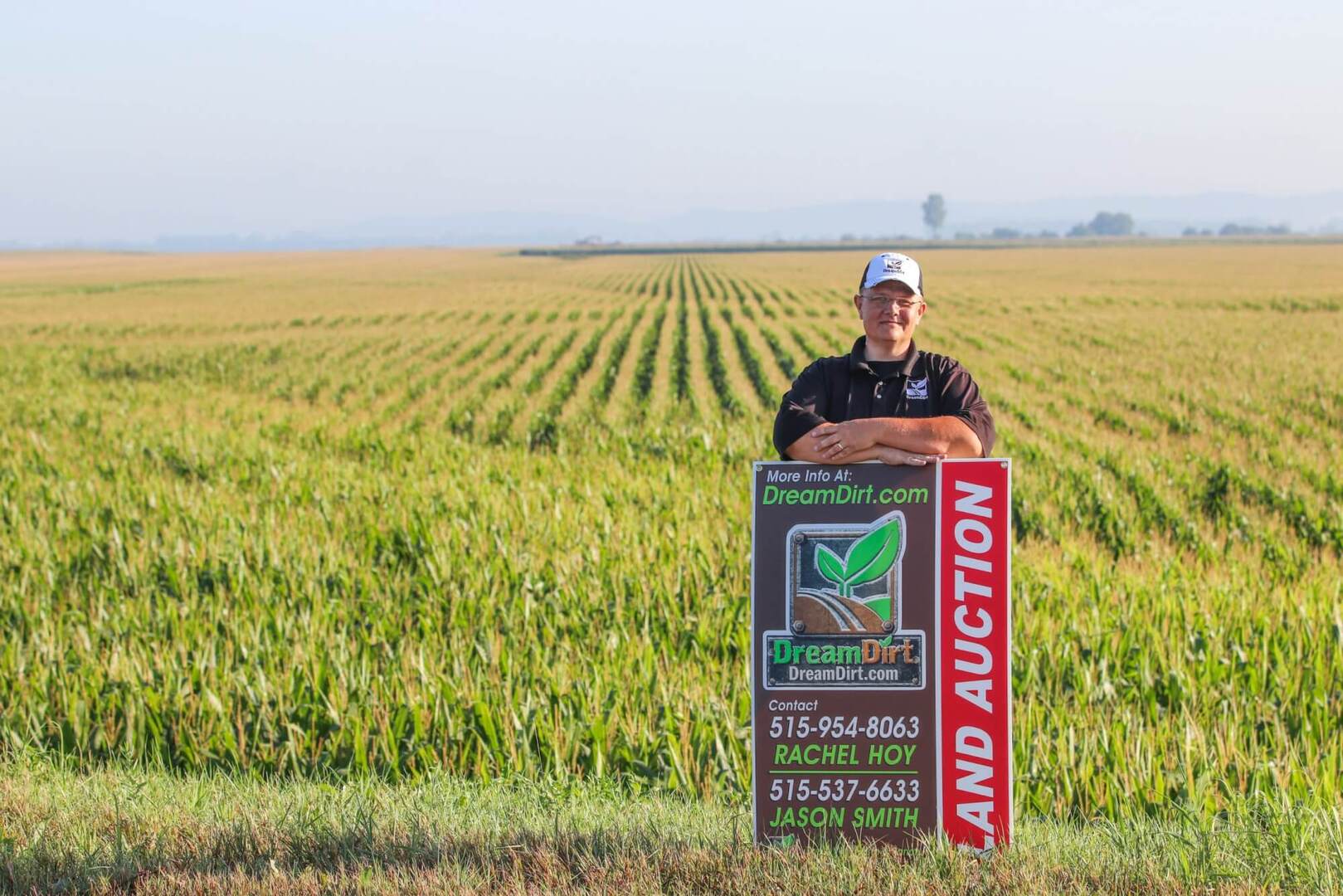
Jason J Smith
Auctioneer & Land Broker
Jason Smith is an experienced farmland broker and auctioneer with extensive experience helping landowners sell farmland across the Midwest. As the founder of DreamDirt and a licensed real estate broker and auctioneer, Jason has worked with hundreds of landowners to navigate farmland sales and create advantageous outcomes.
If you're considering selling farmland, schedule a confidential consultation with Jason to discuss your property, current market conditions and your selling options.
Phone: 515-537-6633 Email: Jason@dreamdirt.com
Request a Valuation for Your Farm or Land Property
Whether you’re ready to start the selling process, or even remotely curious, we will gladly provide you with a free consultaiton with a complementary Market Analysis! If you are in a position to sell land in the Midwest, we want to help you achieve the top of the market on your sale.
Nebraska Farmland Values in 2026: What the Latest Numbers Tell Us
If you own farmland in Nebraska and have been wondering whether land prices are still climbing, leveling off or beginning to retreat, the latest numbers suggest the answer depends quite a bit on what kind of land you own and where it is located. The University of...
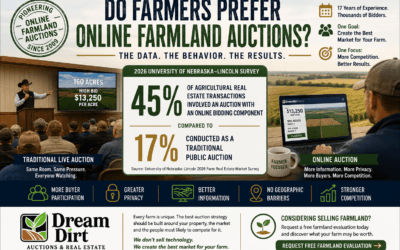
Do Bidders Prefer Live or Online Farmland Auctions?
For generations, farmland auctions looked pretty much the same. Buyers gathered at a community building, sale barn or local event center. The auctioneer stood at the front of the room, and farmers competed against one another for the opportunity to buy a farm. It...
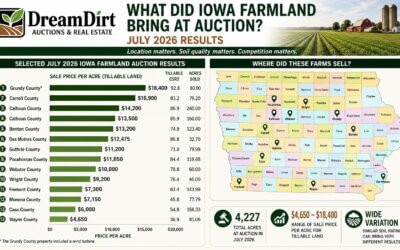
What July 2026 Iowa Farmland Auctions Tell Us About Land Values
July 2026 Iowa Farmland Auction Results: A Stable Market With Wide Local Variation Iowa farmland auctions picked up in July 2026, giving us a larger group of sales to evaluate as we head toward the traditionally busier late-summer and fall land market. A total of...